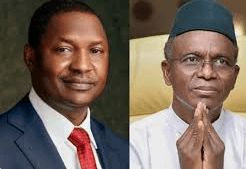
The African Democratic Congress (ADC) has leveled a serious accusation against the administration of President Bola Tinubu, alleging the application of selective justice in the handling of legal cases involving prominent political figures. The party specifically pointed to the cases of former Kaduna State governor, Nasir El-Rufai, and the former Attorney General of the Federation, Abubakar Malami. According to the ADC, the sequence of arrests, inter-agency custody movements, and the overall pace of actions against these two men have triggered serious public concern about whether the rule of law is being applied evenly across political lines.
ADC National Publicity Secretary, Bolaji Abdullahi, issued a statement confirming the party has been closely watching these developments involving its members. The statement suggests a growing perception that the legal process may be influenced by political considerations, a claim that strikes at the heart of Nigeria's democratic principles. This allegation emerges in a climate where public trust in institutions is a recurring theme, adding weight to the opposition's critique of the current administration's governance approach.
In a separate but related political development, the Deputy National Publicity Secretary of the People’s Democratic Party (PDP), Hajiya Farida Umar, commented on a recent court judgment. She stated that the Federal High Court in Ibadan's validation of the Ibadan PDP convention, which led to the emergence of the Taninu Turaki-led executive in 2025, shows the court can be seen as being unbiased. Umar noted this decision aligned with the facts and law that led to the organization of the convention, presenting it as an example of judicial integrity.
However, Farida Umar emphasized that the most important step is the pending Appeal Court judgment, where the PDP has urged the justices to do the right thing just as the lower court did. She further claimed that the ruling All Progressives Congress (APC) is scared of the grassroots presence of the PDP in all parts of the country, despite the APC holding about 30 state governorships. This comment underscores the ongoing intense rivalry and legal battles between Nigeria's major political parties as they jockey for position and legitimacy.
Amidst these political tensions, a religious leader offered a message of social responsibility. The Chairman of the Anwaru-L-Huda League of Nigeria, Garki branch, Alhaji Abdul-Hakeem A. Smith, stated that the holy month of Ramadan serves as a reminder that worship is never complete without compassion. He noted that spirituality without social responsibility is hollow, speaking at the organization's annual Ramadan lecture.
The cleric highlighted that this year's Ramadan comes at a time when Nigeria and the global community face enormous challenges. He listed economic pressure, moral decline, leadership deficits, social inequality, and increasing hardship among the vulnerable as key issues confronting the nation. This spiritual reflection provides a stark backdrop to the political and security discussions, reminding leaders and citizens alike of broader ethical obligations.
In a demonstration of community action, the chairman highlighted the achievements of the League's leadership over the past year. He mentioned that a projected N1.2 billion is being solicited for the completion of a community mosque and Imam's quarters in Kubwa, which has reached 40 percent completion. This project represents a tangible effort at community building and social infrastructure, contrasting with the political disputes and offering a model of localized development.
On the security front, the appointment of Olatunji Disu as Inspector-General of Police by President Bola Tinubu represents more than a routine leadership transition. It arrives at a moment when Nigeria's internal security challenges have reached an apogee of complexity, demanding not only operational competence but institutional reinvention. This opinion underscores the critical nature of the security landscape the new police chief must navigate.
Across Africa's most populous nation, insurgency, banditry, organised crime, cyber threats, separatist agitations, and rising urban criminality intersect with youth unemployment and declining public trust in state institutions. Under the statutory framework guiding the tenure of service chiefs established by the National Assembly of Nigeria, the new Inspector-General is expected to serve a fixed term. This context of multifaceted insecurity forms the challenging environment in which allegations of selective justice and political rivalry are playing out, testing the resilience of Nigeria's legal and democratic institutions.