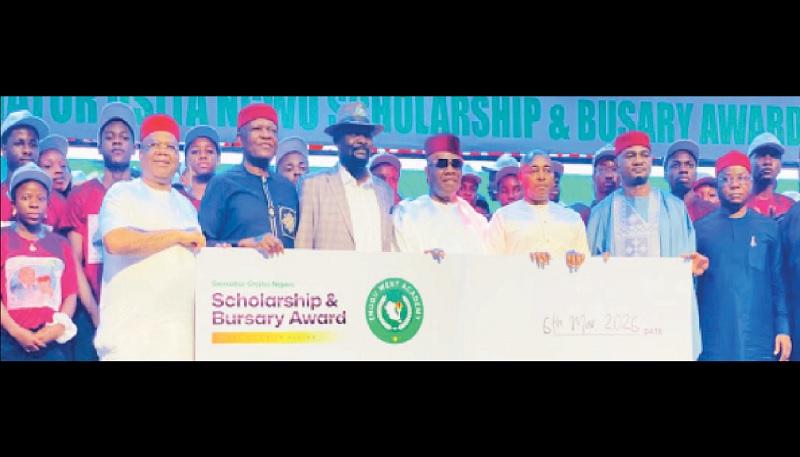
Senate President Godswill Akpabio and Senator Okey Ngwu have launched a N350 million scholarship and empowerment program for Enugu West constituents. This direct cash injection into the local economy represents one of the largest single-constituency development funds announced recently. Its launch signals a high-priority political effort to deliver tangible benefits ahead of future electoral cycles.
The program's total value is three hundred and fifty million naira. In the current Nigerian economic climate, this sum holds significant purchasing power for individual beneficiaries. It is earmarked for two distinct, direct-transfer purposes: scholarships for education and empowerment grants for business. This bifurcation targets both human capital development and immediate economic stimulation.
Scholarships will support the educational pursuits of constituents. This financial support is designed to cover critical costs like tuition fees, textbooks, and accommodation—barriers that often force students to abandon their studies. By reducing this financial pressure, the program aims to increase tertiary education enrollment and completion rates within Enugu West. Long-term, this investment seeks to build a more skilled local workforce.
Empowerment grants are designed to foster business development and economic self-sufficiency. Recipients can use the funds as seed capital to launch new micro-enterprises or as expansion capital for existing small businesses. This component directly addresses unemployment and underemployment by encouraging entrepreneurship. Successful small businesses can create ripple effects, generating jobs and circulating money within the local economy.
The launch highlights the enduring political strategy of constituency development projects. Lawmakers frequently use such initiatives to demonstrate direct, visible impact and cultivate voter loyalty. The sheer scale of this funding, however, sets it apart from typical smaller-scale projects. It reflects the considerable influence of the Senate President in mobilizing and directing substantial resources.
Senator Okey Ngwu, representing Enugu West, is directly involved in facilitating the project. His partnership with Akpabio is not merely ceremonial; it ensures the program carries the weight and administrative backing of the Senate's highest office. This collaboration likely expedites bureaucratic processes and guarantees national-level attention for the constituency's development.
Implementation presents the definitive challenge. The program's success hinges entirely on transparent, efficient, and equitable disbursement. Past constituency projects have been criticized for poor management, favoritism, and funds failing to reach intended beneficiaries. Establishing clear, publicly accessible eligibility criteria and a robust monitoring framework is non-negotiable for credibility.
The economic significance is immediate. An influx of N350 million in grants and scholarships acts as a targeted fiscal stimulus for Enugu West. It increases household disposable income for education and provides venture capital at the grassroots level. This can boost demand for local goods and services, potentially inspiring a cycle of increased economic activity.
Politically, the program is a potent tool. For Senator Ngwu, it is a legacy-defining project that could solidify his political base. For Senate President Akpabio, it demonstrates his ability to deliver major resources to allies and their constituencies, reinforcing his power within the political network. The timing of such launches is often strategic, aimed at maximizing political goodwill.
Future assessments will measure the program's impact on educational attainment and business growth. Key metrics will include the number of students supported, graduation rates, new business registrations, and job creation linked to the grants. The allocation sets a new benchmark for similar constituency projects, raising public expectations for what constitutes meaningful development intervention.
Accountability mechanisms must be established from the outset. This includes forming independent oversight committees with civil society representation, publishing regular disbursement reports, and conducting periodic audits. Without these safeguards, the program risks becoming another opaque fund lost to inefficiency or malfeasance.
The program's launch is just the beginning. The real work—identification, vetting, disbursement, and support—starts now. Its legacy will be written not by the announcement, but by the changed lives and thriving businesses it produces in Enugu West over the coming years.